
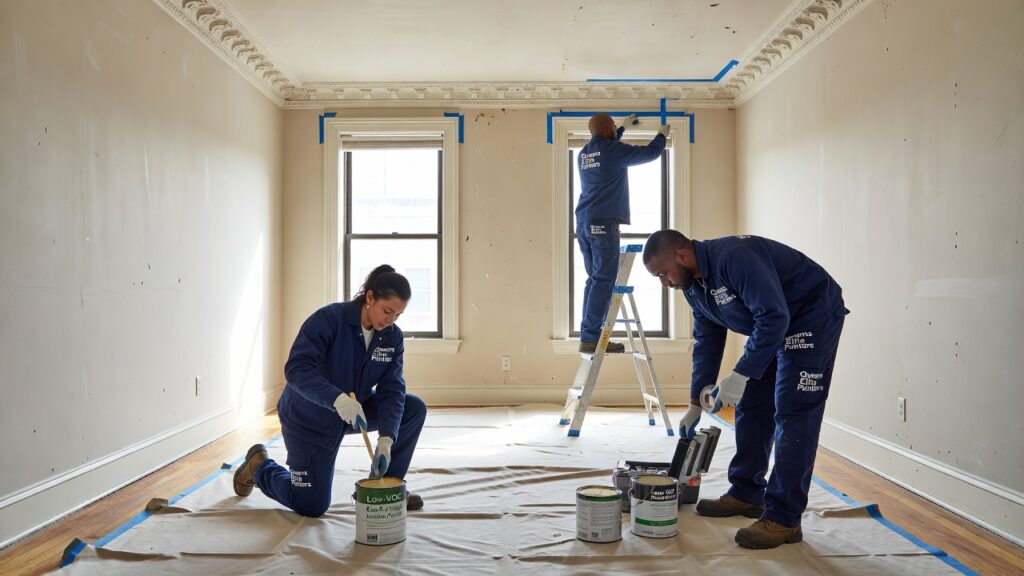
Smart Choice: Licensed and Insured Painters New York City: 2026 Guide for Queens Residents
Hiring a painter in Queens without checking credentials first it happens more often than you’d think, and the fallout can be expensive. We get calls regularly from homeowners in Jackson Heights, Astoria, and Forest Hills who already made that mistake and are now dealing with the consequences: peeling walls two months after a “fresh coat,” no one to call when something goes wrong, and zero recourse because the crew they hired was operating without a license or insurance. When you’re searching for licensed and insured painters New York City, the credential question isn’t a formality in Queens, it’s the difference between a renovation that holds up and one that costs you twice.
Below, we walk through the most common mistakes Queens homeowners make when hiring painters, what the warning signs actually look like in practice, and how a qualified crew diagnoses and fixes both the hiring error and the paint job itself.
Hiring Based on Price Alone and What That Gets You
The symptom here is familiar: you got three quotes, picked the lowest one, and the crew showed up with thin paint, no drop cloths, and finished an entire two-bedroom apartment in Flushing in a single afternoon. Six weeks later, the paint is chalking off the bathroom walls.
The underlying cause is almost always a combination of cheap materials and compressed labor time. Unlicensed operators in Queens frequently cut costs by thinning paint beyond manufacturer specs, skipping primer on bare drywall, and rushing dry time between coats. Without licensing obligations, there’s no professional accountability structure holding them to a standard.
The professional fix: A licensed crew assesses the substrate first. If the previous paint is failing, we don’t paint over failure we strip, sand, and prime before a single topcoat goes on. On a bathroom in a pre-war co-op in Sunnyside, that often means a mold-resistant primer before any finish coat, because those buildings hold humidity differently than newer construction. According to the Paint Quality Institute, high-quality exterior paint jobs can last 10–15 years when properly applied, compared to just 3–5 years for lower-grade paints that gap applies equally to interior work when surface prep is skipped.
Can this be prevented? Ask for a written scope of work before anyone picks up a brush. It should specify paint brand, sheen level, number of coats, and surface prep steps. If a contractor won’t put that in writing, that’s your answer.
Not Verifying Insurance and Getting Stuck with the Bill
A painter falls off a ladder in your Long Island City apartment and lands wrong. Or a drop cloth wasn’t secured and paint soaks through your hardwood floor. If that crew carries no general liability insurance, the liability conversation comes back to you and your homeowner’s or renter’s policy.
New York City’s Department of Buildings requires contractors performing work on buildings with six or more units to hold appropriate licenses and carry general liability insurance of at least $1 million per occurrence. Most Queens residential buildings co-ops in Rego Park, rentals in Woodside, condos in Forest Hills Gardens fall under this threshold. But even for single-family homes in Bayside or Howard Beach, uninsured labor is a personal financial risk that most homeowners don’t fully price into that low bid.
The professional fix: Before we start any job, we provide a current certificate of insurance naming the property owner as an additional insured for the duration of the project. That’s standard practice, not a favor. A contractor who hedges on this says the certificate is “in the mail” or offers a photo of an expired document should not be in your home.
Can this be prevented? Call the insurance carrier directly to verify the policy is active. It takes five minutes and costs nothing.
Skipping the Pre-Paint Inspection on Older Queens Housing Stock
Queens has a remarkable range of housing ages. There are 1920s row houses in Richmond Hill, 1950s brick colonials in Fresh Meadows, and mid-century six-family buildings all over Jamaica. Painting over existing layers in older buildings without testing for lead paint is both a health risk and a regulatory issue.
The symptom often surfaces after the fact: a child’s blood lead level comes back elevated after a renovation, or a landlord gets cited by the city because their contractor disturbed lead paint without an EPA Renovation, Repair, and Painting (RRP) certification. The Environmental Protection Agency notes that volatile organic compounds in conventional paints are a leading source of indoor air pollution, but disturbed lead-based paint is a category of risk that requires entirely separate protocols.
The professional fix: On any Queens home built before 1978, our team checks the work order and the building’s history before proposing a prep approach. If lead paint is suspected, we recommend a certified lead test before work begins. RRP-certified crews use containment protocols, HEPA vacuuming, and proper disposal none of which an unlicensed crew is trained or equipped to do.
Can this be prevented? Ask your contractor directly whether they carry EPA RRP certification and whether they’ve tested for lead. If they look at you blankly, that’s a disqualifying answer in any pre-1978 building.
Choosing Color Without Accounting for Queens Light Conditions
This is a softer mistake, but it costs people real money. A homeowner in Astoria sees a greige on a paint chip under fluorescent store lighting, approves it, and watches it read lavender on their north-facing wall by November. They call us after spending $1,800 with another crew to re-do it.
The cause is diagnostic: natural light in Queens varies significantly depending on which direction your windows face and what’s outside them. A top-floor apartment in Elmhurst with southern exposure reads color completely differently than a garden apartment in Corona with a narrow alley view to the east.
The professional fix: Before we commit to a finish color on any project, we tape large sample swatches minimum 12 by 12 inches and observe them at different times of day. We also talk clients through the LRV (light reflectance value) of their options, because a color with an LRV under 50 can feel oppressive in rooms that don’t get direct sun.
Can this be prevented? Always test on the actual wall, in the actual room, before the full purchase order goes in. Paint stores will sell you sample sizes for exactly this reason.
Ignoring Post-Paint Ventilation Especially in NYC Apartments
Queens apartment buildings are often tightly sealed, particularly in winter. Homeowners sometimes stay in the unit during or immediately after painting and report headaches, eye irritation, and a smell that lingers for days. This is a real problem, not just a minor inconvenience.
Conventional paints off-gas VOCs most heavily in the first 24 to 72 hours after application. In a sealed Woodhaven apartment with no cross-ventilation, that concentration builds quickly. According to the EPA, zero- and low-VOC paints reduce this risk significantly and we use them as a default on interior jobs, particularly in homes with children or residents who have respiratory sensitivities.
The professional fix: We specify low- or zero-VOC formulas on interior projects unless there’s a functional reason not to. We also give clients a written ventilation plan: when to open windows, how long to keep fans running, and when it’s safe to sleep in the room again. That’s not paperwork overhead it’s part of doing the job right.
Can this be prevented? Ask your painter what VOC level the proposed paint carries before the job starts. The answer tells you a lot about how they think about the people living in the space.
Ready to Work With Painters Who Actually Know the Difference
Every problem on this list has a straightforward solution: hire licensed and insured painters New York City crews who work in Queens every day and understand the housing stock, the regulations, and the real cost of cutting corners. According to HomeAdvisor’s 2024 True Cost Report, NYC painting projects typically run 20–40% above the national average which makes it even more important to spend that money with a team who’s going to do it right the first time.
At Masterpiece Painting Services, we’ve worked across Queens from Victorian wood-frames in Douglaston to high-rise co-ops in Flushing and we bring the same licensed, insured, fully prepared crew to every job. Reach out today for a free estimate and a straight conversation about what your project actually needs.
Frequently Asked Questions
How do I verify that a painter is licensed and insured in New York City?
Ask for the contractor’s Home Improvement Contractor (HIC) license number and verify it through the NYC Department of Consumer and Worker Protection’s online database. For insurance, request a certificate of general liability insurance and call the issuing carrier to confirm the policy is active not just current on the document date. In Queens, where many buildings are six-plus units, this verification step is legally relevant, not optional.
Why do Queens painting projects often cost more than the national average?
New York City labor rates, building access logistics elevator scheduling, co-op board move-in rules, permit requirements in some commercial buildings and the higher cost of materials in the metro area all contribute. According to HomeAdvisor’s 2024 True Cost Report, NYC interiors typically run 20–40% above the national baseline. A detailed written quote that breaks out labor, materials, and prep will help you understand exactly what you’re paying for.
Is lead paint testing required before painting a Queens home built before 1978?
It’s not always legally required for owner-occupied single-family homes, but it is strongly recommended and in many rental situations is mandated under NYC Local Law 1. If your contractor disturbs lead-based paint without EPA RRP certification, both you and the contractor can face liability. Any reputable licensed painting crew working in pre-war Queens housing should be able to walk you through the lead testing process before work begins.
Related from Masterpiece Painting NYC: Interior Painting Services in Brooklyn, NY · Professional Exterior House Painting in NYC · Stucco And Brick Painting in Brooklyn, NY